

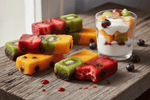
Where Frutifresca Style Treats Actually Come From
, by "Sarah Faneh", 6 min reading time
, by "Sarah Faneh", 6 min reading time
Frutifresca treats carry a history that goes back generations. Here is where these fruit bars and frozen treats actually come from.
Frutifresca treats might feel like a simple frozen snack, but the style of fruit bar behind them carries a history that stretches back generations, rooted in a tradition that started in Mexico and eventually spread across the world.
Most food historians trace this style of frozen fruit treat back to a small town called Tocumbo, in the Mexican state of Michoacán. In the 1930s and 1940s, local families in Tocumbo began freezing mixtures of fresh fruit, water, and sugar around a wooden stick, creating what became known as paletas, meaning little sticks in Spanish. Unlike a typical popsicle, these treats were built around real, visible pieces of fruit rather than artificial flavoring, which set them apart from mass produced alternatives at the time.
One of the earliest and most well known paleterías, or paleta shops, was called La Michoacana, and it is often credited as one of the businesses that helped spread this style of treat beyond Tocumbo. Over time, the knowledge and tradition of making paletas spread through family networks, eventually reaching larger cities like Guadalajara and Mexico City, and later crossing into the United States as Mexican communities brought the tradition with them.
Interestingly, Tocumbo itself grew into something of a paleta capital over the following decades. As families from the town opened paleterías in cities across Mexico and eventually the United States, the town became known informally as the birthplace of the modern paleta tradition, with local legend even referring to it as the cradle of paletas. Some families who began in that small town went on to build entire businesses around this frozen fruit tradition, passing the trade down from one generation to the next rather than treating it as a passing trend.
Like a lot of food traditions, paletas come with a few competing origin stories. One popular version traces the idea back much further, suggesting that Aztec emperors once had servants collect ice from nearby volcanoes to mix with fruit centuries before paletas as we know them existed. It is a colorful story, but most historians treat it as folklore rather than documented fact, since there is little written evidence to support it.
The more reliably documented history points to the early 1800s, after Mexican independence ended Spain's monopoly and heavy taxation on ice. Once ice became more accessible to ordinary people, home cooks and street vendors began experimenting with combining it with fresh fruit, laying the groundwork for what would eventually become the paleta as it is known today. It would still take until the 1930s and 1940s, in Tocumbo, for the treat to take the specific shape and format that spread across Mexico and beyond.
What made paletas stand out from the beginning was the emphasis on real, identifiable fruit. Instead of a uniform, artificially flavored treat, paletas were often made with visible chunks of fruit, giving each bite genuine texture and flavor rather than a single, flat sweetness. Traditional flavors leaned on what was regionally available, mango, pineapple, watermelon, tamarind, coconut, and guava among them, each reflecting the fruit that grew nearby.
This focus on real ingredients over artificial shortcuts is part of why the tradition has lasted as long as it has. It was never about novelty alone, it was about capturing the actual flavor of fresh fruit in a frozen, easy to enjoy format.

Beyond the flavor itself, paletas became something bigger than a dessert in many communities. Paleteros, the vendors who traditionally sold these treats from carts, became a familiar and welcomed sight in neighborhoods, associated with warm weather, community gatherings, and a sense of everyday joy. The tradition carried a strong sense of cultural pride, passed down through families and small businesses rather than large scale manufacturing.
That sense of connection is part of why this style of treat has remained popular for so long, not just because it tastes good, but because it carries a story and a tradition behind it. In many towns, an annual paleta festival still draws thousands of visitors each year, a sign of just how deeply this simple frozen treat became woven into local identity and celebration.
As paleterías spread across Mexico through the mid 1900s, the tradition eventually crossed into the United States alongside the families who carried it. Neighborhoods with strong Mexican American communities became natural homes for this style of shop, and over the following decades, paletas moved from being a regional specialty to something recognized and enjoyed far beyond their original Michoacán roots. Along the way, the flavor lineup expanded well past the original fruit based options, growing to include cream based versions, candy inspired combinations, and playful pairings that reflect local tastes wherever a new paletería opens.
That evolution is part of what keeps the tradition feeling current rather than frozen in time, no pun intended. The format stayed simple and recognizable, real ingredients on a stick, while the flavor possibilities kept expanding to match whatever a new generation of customers was curious to try.
Modern versions of this tradition, like the Frutifresca selection, carry that same spirit forward, offering a range of fruit bars, dessert bars, and specialty treats that echo the flavor variety and fruit forward approach that made paletas popular in the first place. While the exact recipes and production methods vary by brand and maker, the underlying idea remains the same, real, distinct flavors in a simple, frozen format that feels like a genuine treat rather than an afterthought.
Understanding where a treat like this comes from adds a layer of appreciation that is easy to miss when you are just grabbing something cold on a hot day. It is a reminder that some of the simplest treats carry the most history, shaped by generations of families who turned fresh, local fruit into something worth sharing.
You can explore the full range of Frutifresca treats, including fruit bars, dessert bars, and specialty cups, on the Frutifresca menu at Clean River Juice Bar. If you want to pair a treat with something more substantial, the sandwiches menu and smoothie menu are both worth checking out as well. Everything is available at Clean River Juice Bar, located at 23365 Lyons Avenue in Santa Clarita, whether you are stopping by in person or ordering online.

Subscribe to our emails